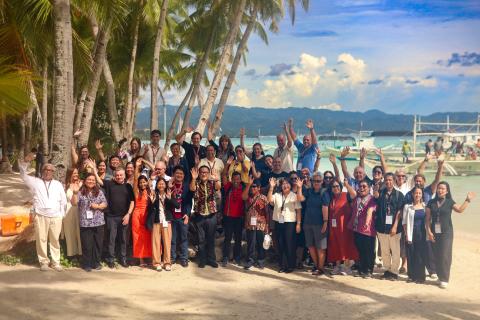
Momentum is rapidly building around global Indigenous research collaborations, with NPM researchers driving key efforts to unite knowledge systems across the Pacific and beyond. A recent milestone in this movement saw Indigenous researchers gather in the Philippines alongside members of the Association of Pacific Rim Universities–Indigenous Knowledge (APRU-IK) Network to advance shared research priorities.
Professor Linda Waimarie Nikora is always energised by such hui and this year she attended along with an Auckland University contingent including NPM board member Professor Te Kawehau Hoskins and NPM co-director, Professor Melinda Webber. The gathering was held in June on Boracay Island, and members left with plenty of mahi to do. “As a network, we are still in our formative years, so it’s about prioritising what’s possible and getting on with it,” says Waimarie.
Collaboration is one of the network’s key priorities and this can take many different forms. She says while conferences are often sold as a pathway to collaboration, they can often be lonely experiences, especially for Indigenous researchers at very large conferences. It’s important, therefore, that Indigenous researchers carve out time to really get to know each other, for authentic collaboration and problem solving to occur, says Waimarie.
A good example of this occurred during the recent APRU-IK hui when a senior researcher from Asia informed Waimarie she was experiencing big problems finding examiners for her Indigenous PhD students. Wanting to hear from others, Waimarie brought together a talking circle of senior Indigenous academics from India, Malaya, China, Mexico and Aotearoa for a series of on-line hui to kōrero specifically about their own issues and to find solutions. “It was an opportunity for people to step into the international collaborative domain, and it was an awesome process. This is the kind of practical process and outcome that being part of a wider Indigenous network can address for the benefit of all,” she says.
Of the 66 member universities, Auckland is the only New Zealand University that is an active member of APRU. One of the network’s biggest issues is getting visibility within their own institutions. So, with others at the Boracay hui, the group video-taped a statement about the important voice and visibility of Indigenous researchers within the APRU network. “The presidents meet every year, so we wanted to give them a wake-up call about the importance of Indigenous staff, Indigenous teaching and research inside their organisations. The University of Auckland is probably a long way down the line in achieving this compared to other universities who have never considered the needs of Indigenous peoples within their institutions. But we are trying to achieve real impact through this network, and it is important that presidents hear from us,” says Waimarie.
One strategy the network is committed to is establishing an international mentoring programme for both Indigenous academic and professional staff. “The benefit of this is about mentoring to be part of a global Indigenous community. It will offer Indigenous people the experience of seeing how different universities within the Pacific Rim operate. The hope is that people might learn a few tips and tricks, take them back to their own institution to benefit them,” says Waimarie.
NPM Operations Manager Marie-Chanel Berghan also attended the Boracay gathering, and she says these hui are invaluable for both researchers and the professional staff who support research behind the scenes. “Strong relationships are at the heart of successful Indigenous research collaborations. Exchange opportunities like this help because you are extending your knowledge, capability and capacity, but the greatest value comes from the relationships we make and sustaining those connections. Those relationships open doors to Indigenous researchers and communities across the Pacific Rim and create opportunities that would not otherwise exist.
She says NPM’s strength lies in these networks, enabling us to draw on international expertise, support our advisory boards and publications, and help us deliver initiatives such as the Biennial International Indigenous Research Conference. “Investing in these relationships strengthens our ability to support Indigenous research excellence both nationally and internationally,” says Marie-Chanel.
Waimarie encourages anyone who is interested in the work of APRU-IK to subscribe to its newsletter and sign up to anything they are curious about. The on-line seminar series is also an excellent way to become more knowledgeable about Indigenous research and perspectives within the Pacific Rim, and this is a simple way to get involved, she says.
“Being part of a global community is important for us in Aotearoa. It allows us to better understand the world and to delight in knowing about it, because it is so very different to our experience compared to most other countries and cultures. Yes, we have something to contribute, but we should be humbled by the efforts that are occurring internationally because they are facing some dire, dire circumstances.”