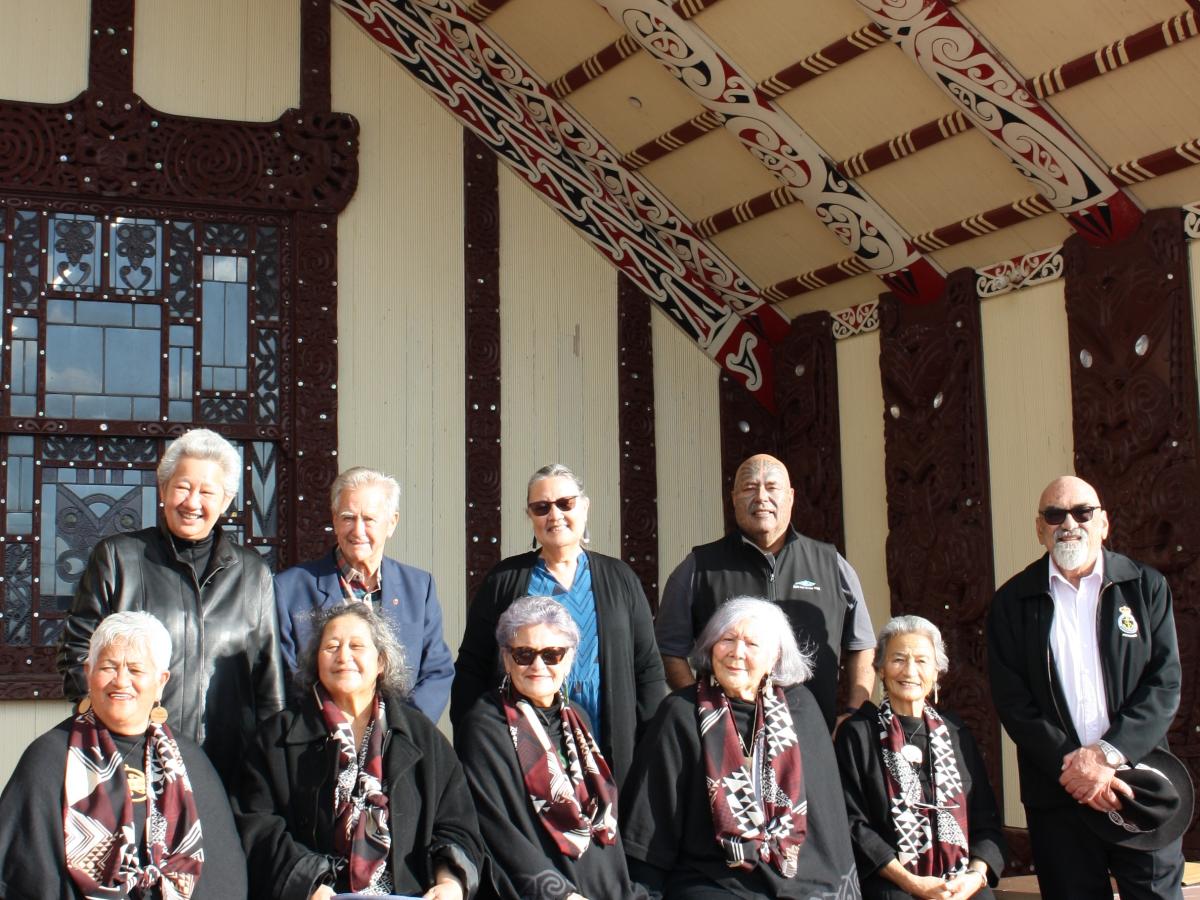
Kaumātua are the heart and soul of marae life and are often the ‘go to’ for guidance on kawa and tikanga. A new report written by NPM Fellow Dr Teorongonui (Josie) Keelan (Ngāti Porou, Ngāti Awa, Tūhoe) highlights just how busy kaumātua are in serving their people.
“You’ll find them at all events, no matter what size, standing up for their people. They are the kaikaranga, kaikōreo, mātanga and tohunga who attend the dawn ceremonies on freezing cold mornings, the tangi, marae events, they sit on trust boards, and they are often the interface between their people and government agencies,” says Teorongonui.
Supported by NPM and The Family Centre, the study was undertaken to better understand the lives of kaumātua: how they serve their communities; their roles and responsibilities; how they pass on their knowledge; their concerns and worries; and support needs. Rather than do a broad-brush national approach, Teorogonui limited her study to kaumātua from Ngāti Whakaue. She says the amount of time, energy and commitment they give to support their marae, hapū and iwi is huge. “They show up rain, hail or shine for their people, but unfortunately, they often do not feel acknowledged for their unwavering commitment," says Teorongonui.
It is this commitment that underpins what it means to be a kaumātua, with those in the study drawing a distinction between koeke (elderly person) and kaumātua. “They were very clear that not everyone has the right to call themselves kaumātua because not everyone dedicates themselves in service the way they do,” says Teorongonui.
Their concept of kaumātua included elderly Māori (both male and female) who were usually fluent speakers of te reo, well versed in waiata and stories of the iwi, knowledgeable of tikanga and and whakapapa (even if not fluent in te reo), had roles such as kaikōrero, kaikaranga, kaiwaiata and kaitautoko, and committed their time to represent the iwi. Not everyone possessed every skill but that did not matter so long as they were covered by the rōpū collectively.
A common theme from the study was the pride and joy that kaumātua felt about their mokopuna learning te reo. However, while te reo was flourishing, there were concerns that knowledge of tikanga and kawa was being lost. “People are not coming to their marae in the same numbers as before and kaumātua are worried about this. People are having tangi at home because of the expense, but the tikanga around tangi in the home is not clear, and that is a concern for kaumātua,” says Teorongonui.
She found that kaumātuatanga was a lifelong process of learning through observation and doing. The early steps tended to begin in the wharekai, learning the principles of awhi, tiaki and manaaki, later culminating in specific roles such as kaikaranga and kaikōrero.
Kaumātua felt that the ability to manaaki could diminish if whānau were not actively engaged with marae and developing the practical skills needed to organise and manaaki their own events like tangihanga and birthdays. “People don’t know how to plan menus or cook for hundreds of people, and they turn up to their own events expecting to be guests,” says Teorongonui.
She believes there are many opportunities to be creative and devise new ways to get whānau engaged with marae. Kaumātua saw much potential in marae-based wānanga, particularly for the transmission of tikanga and kawa.
Technology was less useful, with lack of access being a barrier for kaumātua. “They do not use email, preferring to read from a real piece of paper rather than from a screen. Because they are on fixed incomes, access to expensive computers, phones or the internet is not common, so they are using old phones that they can only call or text on. While it might change in the future, the current cohort of kaumātua are isolated by their lack of technological access and knowledge,” says Teorognonui.
Time spent with whānau was precious, with kaumātua saying that it gave them the most joy and meaning. “Almost every single one lived with whānau and that was something they liked, especially if there were mokopuna. Living with mokopuna gave them a sense of purpose and a reason for being,” says Teorongonui.
She believes there is a simple solution to make kaumātua feel more appreciated for the time and service they give to their people. “Younger generations need to just sit down and have a kōrero with them. Wānanga with them on a specific topic. Talk about the dreams they have for their whānau because they all have dreams about what they want for whānau. Then begin to work on those dreams – gather the rest of the whānau around to make their dreams come true.”
Ētahi atu pūrongo · Other articles
Kōrero with one of our new KĀHU members, Associate Professor Andrea Reid Stewart
Which tribe/people and area do you come from?
Nisg̱a’a n̓iiiy̓. Ksim Lax̱sgiik n̓iiy̓. Wilps Kwa’kaans wil w̓itgwiy̓. Lax̱g̱alts’ap wil jogay̓. Epekwitk wil w̓itgwiy̓.
Paternally, I come from the Nisg̱a’a First Nation in northwestern British Columbia, Canada. I belong to the Lax̱sgiik (Eagle) Clan and Wilps (House) Kwa’kaans. These are the homelands I live in today, in the Nisga’a Village of Lax̱g̱alts’ap. Maternally, I am of Irish ancestry, and was raised by my mother where she too was raised, on Epekwitk (Prince Edward Island) in Mi’kma’ki on Canada’s east coast.
What is your specialty area of research?
I have the immense privilege of running a collective based at the University of British Columbia which is a community of Indigenous scholars and allies that places the needs and interests of Indigenous Peoples at the heart of all that we do. At UBC, I am a Canada Research Chair in Indigenous Fisheries Science, where I focus both on addressing some of the most urgent challenges facing aquatic and fishing systems today, while working to redefine how fisheries science itself is conducted. I and we work on a range of beings (from salmon to sturgeon to crabs to oolichan), as well as across ecosystems (oceans, estuaries, fresh waters) and disciplines (aquatic ecology and conservation, environmental science, Indigenous studies, social science).
What does flourishing Indigenous futures mean to you?
At the Centre for Indigenous Fisheries, we aim to engage in and restore healthy relations between fish, people, and place. We believe that conducting collaborative, just science strengthens our research praxis and its applications. We share in a commitment to prefigurative science, wherein we embody the future we want in the actions of today. The flourishing future, and indeed present, I and we are working towards is one where Indigenous sovereignty is respected and the deep interconnections between fish, people, and place are recognized and protected.
Why is international connectedness important for Indigenous people?
Waters and fish do not concern themselves with geopolitical borders. There is a fluidity to their existence, an ability to move around or through obstructions, that we all could stand to learn a lot from. I love the cross-pollinating possibilities that come with working across contexts and cultures, and believe that our advocacy work (essential to our science) is strengthened through international solidarity.
Can you tell us about a cultural practice or ritual where connection is celebrated?
Here in Nisg̱a’a Territory, we have an annual celebration that marks the start of our new year: Hoobiyee. Through multiple days of singing, dancing, and feasting, we celebrate the return of saak (oolichan) to our waters where they break winter hunger. They are known as our saviour fish – a tiny fish that chose to save an entire people.
Rūnanga and Researchers Combine to Re-Cloak Whenua
The re-cloaking of a former sheep farm on Te Pātaka o Rākaihautū (Banks Peninsula) is giving researchers an opportunity to support the Wairewa Rūnanga in its plans to create a thriving ngahere and mahika kai on the whenua.
Rūnaka chair and former NPM post-doctoral fellow Dr Matiu Prebble and Professor Shaun Ogilvie are leading the research and hope it will also benefit other communities around the motu.
Wairewa is one of the 18 papatipu rūnaka of Ngāi Tahu. It was able to reassert its mana over the whenua after sheep farmer Jim Wright bequeathed the farm to them in the early 2000’s. Much of the 280ha land is steep and highly eroded pastoral farming country, stretching down to the coastline, meaning there are multiple terrains and ecosystems for the Rūnaka to consider and care for.
Initially unsure how to manage the farm in the best interest of whānau, the Rūnaka underwent a lengthy process of consultation and trials before making the decision to recloak. Kaumātua Theo Bunker was key in getting the decision over the line. “Uncle said ‘look the whenua has been so badly treated for generations now, all I want is to have a really beautiful ngahere back here for my mokopuna,’ and that was how we came to make the final decision,” says Matiu.
Matiu (Kāti Irakehu, Ngāi Tahu Whānui) and Shaun (Ngāti Awa, Te Arawa) have enlisted the help of their third year University of Canterbury students to understand the consequences that re-cloaking might have on the emerging ecosystem.
Now in its fifth year of recloaking, many of the 300,000 trees planted are now at head height and the whenua appears to be flourishing. However, with the transition from grass to forest habitat, pest monitoring and management have become a priority. Without grazing sheep, and a temporary abundance of grass seed, there is a risk of increased pests such as mice, rats and stoats, says Shaun. To monitor this, Shaun’s students are recording the pest species populations and trying to understand how they impact the two native gecko and two native skink populations on the whenua.
While re-planting comes with its own challenges, the benefits of re-cloaking are endless. Not all the benefits are visible - some may be occurring beneath the surface. Soil erosion is a massive problem on the steep slopes and one of the possible benefits of re-cloaking is greater soil stability. “Our researchers are looking at whether the plants are slowing down erosion and if the new plants are capturing moisture in the upper catchments. Many of our streams are eroding away especially in big rain events, and we’ve lost a lot of whenua in the lower catchment here, so it’s important to ascertain whether re-cloaking can help prevent this, says Matiu.
The research findings will be transferable to other regions grappling with erosion and extreme weather events, he says. “The other benefit of this research is that it keeps our Rūnaka informed about what is occurring on their whenua. This project is a great way for young researchers to contribute to Māori communities as well as to the environment – it shows the mahi they are doing is working to help solve real issues,” he says.
Because the land block is not far from Christchurch, the Rūnaka aspires for it to be a place to explore solutions for land regeneration and to show what is possible when Māori are kaitiaki of our own whenua.
“In thirty years’, we have a vision of seeing the kererū living in the ngahere instead of deer. We want this whenua to be a place to sustain our mahika kai, like it was before the 1800’s. Our Rūnaka-led research will help the ngahere as well as our rivers, streams and coast. It will continue to be a place for tuna and pūtakitaki (paradise duck) to be harvested in sustainable ways, based on mātauranga-guided science. We aim for this to be a place for people to connect with their whenua, to connect with each other and one day hopefully to connect with more of our traditional ways of gathering kai,” says Matiu.
Self-Screen Success for Wāhine
Cervical screening rates have dramatically increased since 2023 and wāhine Māori can be credited with helping achieve this success. Māori rates for cervical screening have improved significantly to 2026, jumping over 12 points to 69%. The results for Pasifika women are even better, leaping 20 points to nearly 76%.
This drastic improvement comes after a move to a national self-screening programme in 2023 with researcher, Dr Kendall Stevenson (Ngāti Awa, Ngāti Kurī, Ngāpuhi) crediting the input of Te Tai Tokerau wāhine helping make human papillomavirus (HPV) self-testing a reality for the rest of the country. HPV is a virus that can lead to cervical cancer and Kendall was a part of team who wanted to look at ways of improving screening rates.
She was part of Te Tātai Hauora o Hine research team, led by Professor Bev Lawton (Te Aitanga ā Māhaki). In 2017 the team went north to trial a new way of screening with wāhine who were under-screened or had never screened. Wāhine Māori have the highest cervical cancer mortality rate in Aotearoa and addressing this injustice is vital, she says.
Researchers were met with an enthusiastic response from wāhine in Te Tai Tokerau who were keen to share their perspectives and take part in the Health Research Council funded project which was a random controlled trial (RCT) for the HPV self-test, says Kendall.
Many participants expressed a strong desire for screening but the invasive nature of cytology was a significant factor contributing to their hesitancy. Women also reported reluctance in making time for their own health, says Kendall. “We know as māmā, we are often the last to put ourselves first and the need to find childcare while accessing health care adds difficulty for busy mothers. There is also historical trauma regarding women’s health care, particularly cervical cancer, as well as racism that were all parts of the layered reasons Māori women were put off screening with the speculum,” says Kendall.
While clinicians saw screening as a necessary medical procedure, wāhine expressed more nuanced perspectives. “From a women’s perspective, they saw the cytology screening as a highly invasive procedure, forcing them into a vulnerable state, where they lacked bodily autonomy. Some wāhine Māori also talked about the sacredness of their female bodies and how they are literally a portal from one realm to the tapu of te ao wairua. They told us of their whakamā in having to expose themselves to strangers without protection which all added to their feelings of vulnerability,” says Kendall.
She believes the success of the HPV self-testing programme is an indication of what can happen in health when you listen to the people you are trying to help. “During the RCT, women told us they felt they were winning with the self-test because they had an opportunity to do something for themselves on their terms. Importantly, they were also having conversations about health and recommending the self-test for their daughters, nieces, and nannies. We were having nannies who were having their first screens.”
Kendall says that there is a need for people to better understand HPV because it doesn’t just impact cervical cancer, HPV is also implicated in head and neck, anal, and penile cancers.
With the success of self-testing, Te Tātai Hauora o Hine researchers in partnership with the Cancer Society are committed to eliminating cervical cancer in New Zealand by 2038. “We have improved screening but now we need to improve the other pillars such as improving vaccination, diagnosis and treatment,” says Kendall.
“I really love that Te Tai Tokerau wāhine had such a massive impact on making self-screening a reality for other women around the motu. It shows that our wāhine Māori are unbelievable and know what is healthy and how to be well. Sometimes we must just get out of the way and make things happen on their terms.”