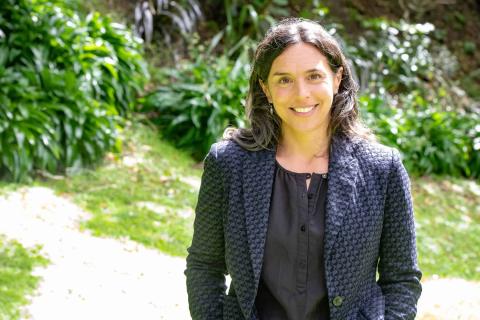
The broader impacts of hapū-based research are not always immediate, often emerging long after final research reports have been filed. A powerful example of research with an enduring legacy is a 2018 study led by Professor Maria Bargh, whose influence is still felt today.
Maria undertook the NPM supported research in collaboration with Te Rūnanga o Ngāti Kearoa Ngāti Tuara in the Rotorua region. The main goal was to identify the impact of pests on Te Horohoroinga-o-ngā-ringa-o-Kahumatamomoe, the maunga of Ngāti Kearoa/Ngāti Tuara.
Gathering baseline data was an essential task of the project team which comprised Maria, Melanie Mark-Shadbolt and Kataraina George (all who whakapapa to Ngāti Kea/Ngāti Tuara). They were joined by Tame Malcolm (Te Arawa) and summer intern, Ellie Tapsell (Te Arawa).
The NPM grant helped fund the cost of data gathering which, in turn, helped generate solutions. “What we found was that our maunga was unwell. There was a heavy prevalence of pests including possums, rats, as well as stoats and ferrets, wild pigs and deer, and while the maunga looked lovely from a distance, it was struggling,” says Maria.
Good information was essential and the research team provided fact sheets about the manu and ngahere on the maunga, and gave presentations to the hapū and local neighbours.
Based on the data gathered, the Rūnanga responded with a variety of solutions including supporting an initial 1080 drop, years of trapping and monitoring. Maria says the maunga was re-energised by the project and the impact reverberated long after its completion.
One of the unexpected outcomes of the research was renewed attention on governance of the hapū Māori Reservations, a new focus for Maria who is now co-chair of the Reservation Trust for Horohoro Maunga. “With the predator free project, it became clearer that the governance of our hapū Māori reservations needed attention - to be ‘tidied up’ with membership needing to be updated, systematic records kept and AGMs held,” she says. The refreshment of reservation governance was positive, leading to a renewed vigour and commitment to the environment, marae and wāhi tapu.
The project was also empowering for the original research team, sparking an even bigger appetite for research and environmental leadership.
Today, Kataraina George is managing a native plant nursery for the hapū lands Trust Paiaka and has extended her pest control expertise to neighbouring blocks, including Department of Conservation land.
Tame Malcolm is now undertaking a PhD focused on mātauranga-based methods of pest control with a focus on possums (supervised by Maria) and is also Chief Executive of Te Arawa Lakes Trust.
After the project finished, summer intern, Ellie Tapsell went on to lead other whānau based environmental projects, and completed a Master of Arts in Māori Studies on ‘Transitioning Environmental Governance In Aotearoa: Tikanga Māori And A Political Ethic Of Care‘ under Maria’s supervision.
Melanie Mark-Shadbolt has remained a cornerstone of the team, providing leadership and advice when needed. Today she continues to inspire through her leadership of Vision Mātauranga for the Resilience to Natural Hazards Platform, and as Director of Te Tira Whakamātaki.
“The project really has a massive legacy both for the hapū, our maunga, and supporting researchers to engage further the research space. Like many research projects that involve hapū it has provided a little spark that lit a fire with real impact and purpose,” says Maria.